 House of Saddam is a four episodes TV drama that charts the rise and fall of Saddam Hussein from 1979 to 2003. A co-production between BBC Television and HBO films, the series began on Wednesday 30th July on BBC Two in four parts. I watched episode one of the show, till now, and first impression is having actors with comics-like facial resemblance to the real persons was deliberate - Saddam was much more skinnier that Yigal Naor when he was vice president - Saddam started to gain weight during the Iraq-Iran war. This also include all other characters in the entire show, such as a teenager look-alike Barzan (Saddam half brother), a plumpy funny Ali Hasan Al Majid, and a big headed gloomy-faced Tariq Aziz. Having a handsome Hussain Kamel Al Majid (played by whom I consider a genies and brilliant young Egyptian actor Amr Waked) can prove more to this formula.
Another thing I was not comfortable with while watching the first episode is the way English was spoken: 99% of the actors speaks English with Iraqi or middle eastern accent (including the same typical grammatical mistakes used), with Arabic words thrown here and there in every sentence, such as habeebty (beloved one for a woman) or Ammo (uncle). It is like I am hearing Ahmed Chalabi speaking during an interview with CNN or BBC.
The substance of historic material chosen for such a drama work intended for TV viewers is new, which is good to shed light on some details that only known to book readers or to an Iraqi who used to be close or attached personally to these events! Yet, there were many changes to the real events. I don't know if such deviations were made to inject some more dramatic aspect to the show, or the writer was referring to false references! For example, Adnan Khairalla, Saddam's brother-in-law, was not Iraq's minister of defense in late 1970's. In addition, Hamdani (in real, his name was Adnan Al Hamdani) was among other Iraqi politicians who have been detained and executed collectively after the notorious revolutionary command council meeting in July 1979. He was not shot in the head by Saddam himself at the latter's house as we saw it in the show.
As I said, there are some strong details close to reality about the life of Saddam and people around him, such as the powerful personality of Saddam's mother - I don't know if she went that far of being personally interfering in her son's choices of selecting loyal people around him, though! In addition, the use of advanced technology and people resources on many shots were perfectly recruited - the use of live pictures of Saddam in different places merged with the help of computer effects of that of "the new Saddam among the public".
I laughed big at a scene from the show when Saddam and his son were standing at the top of a hill, in presumably the town of Tikrit, the birth place of Saddam. He was looking with sharp eyes in to the horizon, where a big circled green spot of palms stretched an area down the valley in the middle of the yellow rocky desert. Then he starts telling his son about the glory of Iraq:
"look around, Uday, look around! This is the land between two rivers. The first armies and empires were found here. Do you know that the first law was written here? This is the cradle of civilizations. We are lucky Uday..." But young Uday was distracted by something, and looked bored. He was continiousely moving his head up and around, staring at the emptiness of the high hills surrounding. There comes a pause, silence, with Saddam like lost in his emperial thoughts until Uday turns his head to his father's side and asks with obvious stupidity and wonder on his face:
"Papa? I am hot"
Saddam face turns from that of cogitation to fury when his eyes set on his son. With disgust and hidden rage he asks Uday: "have you heard a word I said?" His rage was clearer when his voice became much louder "... of course you feel hot... we are in the desert... drink some water..." Saddam then walks dissappointed passing his son with large steps, and in Arabic he curses Uday saying "God damn you, and that who gave birth to you" (انعل ابوك لابو اللي بزرك) . He snaps at Uday to follow him and continue "I wished I brought Qusay with me instead".
I see this show as a nice attempt to cover the political rise and fall of a ruthless dictator like Saddam, but for me (and many others I talked to) it is an imperfect work. I didn't watch the followup to the series (episodes 2,3 and 4), but covering more than two decades of brutal tyranny with only four episodes would also mark this work as imperfect. They managed to show how cold-blooded this man used to be, it has been reflected by the main actor excellently, but crafting such a story into a TV drama deserves more than that, and would really be much better if more attention to other small details and segments, especially that there was an obvious and hard effort on digging down massive and detailed historic events clearly taken from people lived within that period or government documentation and footage's (like of Iraq-Iran war and Saddam TV propeganda). I don't believe stories about the makers of the series getting in touch indirectly from Saddam while he was in US custody, or through the lawyers of Tariq Aziz, according to some media sources!
Wednesday, August 20, 2008
House of Saddam

Sunday, June 01, 2008
Vacation & Memories
 An Iraqi friend went for a week visit to the United Arab Emirates last month. Two days after his arrival I decided to call him and see how he's doing, he was not in a good mood, because first thing happened at the airport was a fight with a security officer that according to my friend was not polite at all. I was surprised because as far as I know the security and passport officers are not rude, on th econtrary, they are very calm and very polite. Anyway, after few minutes of that phonecall, I received an SMS message from him. He said in it: how come most of men in this country have Uday beard-style - that is very carefully light shaven! He meant as a joke, of course, but it rang a bell in my head when he mentioned Uday, of course, Uday is Saddam Hussain's son who was killed in a fight against the US forces in Mosul, north of Iraq.
Monday, January 07, 2008
Human Weakness
 During an interview conducted on Al Baghdadiya satellite TV station with Faisal Al-Yasiri, known Iraqi TV director and former head of Iraqi Television station before the fall of Saddam's Regime, he shed some light on his days during the making of the controversial political show "Al Malef" (the dossier, in English), which is a weekly show consist of an interviews with ministers and government officials from Saddam's regime. Al-Yasiri explained how some ministers were dead afraid of their own answers they used to give to their host on the show. They even asked Al-Yasiri more than once after the recording of the interview to edit them and erase some of their answers so they "won't be misunderstood by others"!
Wednesday, November 07, 2007
Saddam Warning
This video was filmed during the Iraq-Iran war. I am not sure if this was a meeting of Ba'ath party officials or military officials, I don't know, but Saddam was saying "I swear to God, If I hear any of you talk to any citizen or to any Ba'athist, I am going to chop his body in four pieces with my own hands. Is this clear? Until a decision to be made regarding your fate, get out of here! God damn you"
The second video expose how Saddam feels to those who who oppose him by saying that he would not care less about those who opposes him, whether they are one or two or three thousand people stand against him!
Wednesday, October 24, 2007
Baghdad Burning At The Border
 I read today a post from Baghdad Burning blog. It tells the story about the situation of Iraqis at the broder between Syria and Iraq. A very strong and emotional post and it struck me how time did not change, in fact it got worse! more Iraqis are forced to leave because of their government, and the situation put forcefully on them!
Monday, February 05, 2007
Bushra Al Khalil Disclose New Information
 Some identified her as the only feminine member of the defense team for the former Iraqi dictator, Saddam Hussain. She is mostly known for being kicked-out twice (the second time having guards escorting her by force out) from the court room during the trial of Saddam and his aides on the Dujail case. At that time she accused the judge Raouf Abdel-Rahman of “having complex issues towards women”, but then she concluded and kept on saying to the media then that the real reason for removing her from court is the fact that she is a Shiite who was defending a man who is most hated by Iraqi Shiite!
Bushra Al Khalil was born in the south of Lebanon. Her uncle, Mohammed Taqi al-Faqih, was a student of Iraqi Shiite figure Sheikh Mohsen al-Hakeem in Najaf. She was graduated from Beirut University in 1979 with a Degree in Law.
After the execution of Saddam Hussain, many Iraqis thought that old and new faces they  became familiar with seeing on TV during the trial from Arab and non-Arab lawyers defending the former dictator would be vanishing forever. However, there are people like Bushra Al Khalil who found profitable attempt to gain fame by poping up her head from time to time and play the same tune of bringing up Saddam and his regime. In an interview recently by Al Arabiya Satellite Channel, Bushra Al Khalil told her host that the former Iraqi regime is innocent from the killing of Ayatoallah Mohammed Mohammed Sadiq Al Sadr, the prominent religious Shiite leader and the father of Muqtada Al Sadr in 1999 by Saddam’s Secret Intelligence Services, and the truth is that a Shiite Iraqi group (referring to Al Hakeem) has close ties with Iran is the real responsible for committing that crime.
Before he died, Mohammed Mohammed Sadiq Al Sadr was put by Saddam’s regime under house-arrest for many years in his home town of Najaf, because he refused to praise for the life and achievements of Saddam during his weekly Friday prayers. In addition, Al Sadr’s Friday prayers attracted hundreds of people, which by any means can be considered grave danger to Saddam and his iron grip on the Iraqi population as the sole leader. The official story of the Ayatollah’s death says that he and two of his sons had a car accident and he died on the way before arriving to hospital. However, other sources say that he was assassinated while he was on his way back home from his office in Najaf.
From her point of view, Al Khalil said that “one of my friends from the former Iraqi regime used to be responsible for the “Shiite population” told me that Saddam and Al Sadr used to have a good relationship! Saddam allowed Al Sadr to have Friday prayers in front of masses of people!!” She also added that Saddam liked Al Sadr and wanted to make him more influential within Iraq due to his Arab origins. Bushra Al Khalil also mentioned that Saddam sent a condolence letter to Al Sadr’s son, Muqtada, in 1999, and all the media announced or published that letter to the public, in order to show how much the Iraqi president had sympathy. She also supports the claim that Al Sadr has been assassinated, however, she points the finger to Baqir Al Hakeem, another distinguished religious Shiite figure (and the brother of Abdel Aziz Al Hakeem)!
Bushra Al Khalil align herself with the Arab nationalists who believe that a conspiracy exist to divide the Middle East into small nations based on sectarian and ethnic bases. This can be clearly seen with her analysis on the assassination of Rafiq Al Hariri by saying: "If we look at the way the assassination has been conducted, it is very sophisticated, I knew al-Hariri's security measures - no local system could have breached them”… "The question is, who stands to benefit from his death? Syria's enemies. I think al-Hariri's death is part of the plan to divide the region into tiny helpless sectarian states. This plan has started in Iraq and it will continue to hit all other Arab countries." The Lebanese lawyer is like millions of ordinary Arabs; They are looking and praying for day when another leader will come and unify them, defend them against any aggressor, free their occupied cities, stop corruption, spread justice, and provide them with good and comfortable life, for them and for their children. This became stronger after the US invasion of Iraq, and the US biased-stand towards the Palestinian-Israeli conflict. The result? chaos in people opinions; mixed feelings towards current political, religious and social events, and even more chaotaic nature regarding the relationships among Arab regimes. The Arabs reached a level where concept of right and wrong has been disregarded and redefined.
Bushra Al Khalil said on a number of occasions that defending Saddam is a national duty of an Arab opposed to American hegemony duty of an Arab opposed to American hegemony on the whole political system in the Middle East. I wonder, how come 26 years of experience Al Khalil gained from practicing law did not teach her how to recognize a murderer from an innocent! There are two options here: It is either that Bushra Al Khalil has another definition for Arab nationalism, by defending any tyrant used to rule the Arab countries, and, defending Saddam is just a matter of big bucks and fame, or her Arab nationalism is just a fake, and the whole thing again is a matter of big bucks and fame. In fact, she shares the same crime of causing damage and division by defending the man who caused great disasters of death and destruction to the Arab nation.
Will be better if Bushra Al Khalil worked for the rights and just of the Iraqi people instead! It would honorable to her if she raised her hand against the occupier without indulging herself into the adventure of defending the butcher of Iraq! Really! If her heart is really torn apart for Iraq and the Iraqis, why do I keep on hearing her praising the man who was the only reason Baghdad burnt to the ground? Anyway, Baghdad will be alive and will shine again; there is no doubt about that! People and history books will tell stories on how this glorious and beautiful city kept on rising up against forces from east and west, from strangers who tried to wipe it and its people out but kept on failing. Among the stories, the story of Bushra Al Khalil will remain a shameful one for being one of those who wanted to reverse justice by defending one of history’s most tyrants and mass-murderers mankind had ever witnessed?
Monday, September 25, 2006
Whom the pope should talk to?
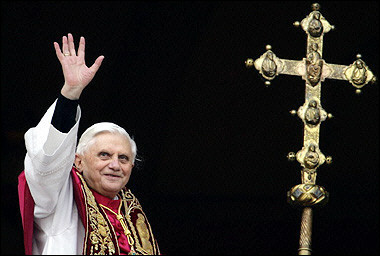 Today early morning news headlines were focusing on two events: The first event was about Judge Muhammad Oreibi al-Khalifa ordering Saddam Hussain to leave after refusing his request to be let out of his metal cage. This is the second time that Saddam being thrown out of the court room by the new judge. The second event was of Pope Benedict XVI meeting envoys from 20 different Muslim countries where he expressed “total and profound respect for the Islamic faith”, and he emphasized on "strengthening ties between Catholic Christianity and Islam".
After reading the news about the pope meeting with the Muslim envoys, I was wondering about something: among all Muslim countries, whom the pope should talk to?
The pope represents the Catholic church, he is the figure where people and countries from other cultures and various religions all around the world can have a dialogue with. The puzzle is to look the other way around: if the pope want to address the Islamic world, whom he should go to? is there a leader or even a representative of the Islamic nation where he can initiate this "dialogue of civilization"? We all know that in the Muslim world there is no unity among its countries.
There is no single alliance that consists of a number of countries where we can point our fingers and say "ok, this can represent the majority of the Muslims, so the pope can start from there"
Lets not involve the Islamic Conference Organization, because everyone knows that it is just a symbolic gathering of Muslim countries from all over the world.
I might think of Saudi Arabia, with obvious reasons: Mecca. But what about Iran? The strongest and soon to be (if not already) the most powerful Islamic country in the region with its military might. If we start talking about either Saudi Arabia or Iran, then we are drawn into the Sunni / Shiá dilemma, oh no, not again!!! What about Egypt? will be the one who can be symbol for the Muslim country that the pope can have a conversation with? Especially if we take into account its status among the Arab countries! I thought of Morocco, especially that the king still carry the title "Amir Il Mo'meneen". This will give the traditional aspect of Islamic monarch and maybe legitimacy? will that be enough to qualify? What about Turkey? Maybe, considering its ties with Europe and Turkey’s appeal to join the European Union!
Wait a minute, Iraq would be the best candidate, yess!!! I am not joking, really! It is the country where Sunni and Shiá used to live with each other, marry from each other and do not despise each other.... they are the symbol of Islamic unity… but oh no, not anymore! for a fraction of a second I started dreaming of old modern Iraq.
Back to reality, what other country can qualify to be that representative country of the Muslim world that the pope can address in his attempt to "strengthen the ties between Christianity and Islam”??
Lets put the Arab world aside and go to non-Arab Muslim countries: Is Indonesia a candidate? Maybe, especially with its most populous Muslim-majority nation in the World. However, with the atrocities exchanged between Christians and Muslims every now and then, one can have second thoughts. However, will Malaysia or Pakistan be good candidates? Before answering the question, there is another one, a bigger one, I consider it a very essential, in fact a dangerous one: What is the reaction of other countries when one country has been nominated? Will country A be happy for country B and back it up, or will country A consider it as a competition and will turn its back instead of backing country B up with all sorts of support?
It is either the pope aware of such a situation in the Muslim world and he is just playing it safe, or he is forgetting that the Muslim world is far from being united to let one individual country represent them, especially now.
In second case, I only wish the pope all success because he will really really really hard time, and I doubt that he will initiate this “dialogue of civilization” the way it should be.


